You know when a book is really popular, but you read it and you just can’t understand why people rave about it? That was my experience with Done and Dusted by Lyla Sage, the first book in the Rebel Blue Ranch series.
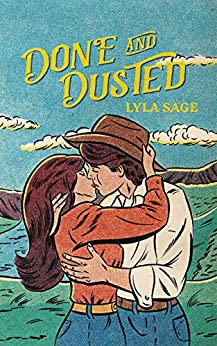
I listened to the audiobook of Done and Dusted, narrated by Stella Hunter and Aaron Shedlock, in a single day. It was a quick, easy listen, clocking in at just about 7 hours. I waited over 6 months for my hold on the audiobook to become available at my local library because of the high demand.
I thought I’d love it — a brother’s-best-friend trope relationship, a Western setting and horseback riding elements? Sign me up. I’d seen this book all over Instagram and TikTok, but after finishing it I don’t understand where the hype is coming from.
My main complaints: show v. tell, underdeveloped characters/character relationships and not a strong enough sense of place given the importance of the setting to the story. Sometimes books can be too long, but in this case I think Done and Dusted was too short to deliver on its premise well.
Issue 1: There were too many opportunities where instead of developing the characters’ relationships through action AKA “show,” Sage would just tell us in a quick summary what happened or mention time passing.
Example: we saw one, maybe two brief riding lessons between Luke and Emmy. After the first, Emmy lists off things she learned about Luke off-page rather than showing us snippets of the conversations themselves, or a montage of the lessons.
In that same vein, Emmy is seemingly magically cured of her PTSD and other mental health struggles, without going through much meaningful growth or challenge on the page. Where is the practicing? Where is the failing? She’s suddenly just fighting fit to break records racing in front of her community again at a big competition? It makes no sense.
The core conflict of Emmy and Luke’s relationship is that Emmy is the younger sister of Luke’s best friend. Why do I know that’s the core conflict? Because Luke tells us a million times as he attempts with 5% effort to stop the romantic and sexual feelings he’s developing for said best friend’s sister. And the conflict really didn’t feel like a conflict at all, because there was no gradually escalating tension – where were the increasing moments of intimacy? The near misses around her family? The real sneaking around and suspicion from Gus?
What’s the point of a brother’s-best-friend set-up if we’re not going to get any of that?
Issue 2: The characters and their relationships were underdeveloped.
For me, aside from my beef with the development of Emmy and Luke’s relationship, the most glaring example of this was in the lack of developed intimacy between Luke and Gus on the page.
One reason Luke endlessly thinking “I can’t be with her, she’s my best friend’s sister” bothered me is that I didn’t buy into his closeness with Gus. Where are their moments together on the page? What is establishing their friendship as a strong bond that would be harmed by this new relationship? Unfortunately, not much. While we get some interactions between them and some info about their past, their relationship just wasn’t the plot pillar it needed to be for a set-up like this to have real payoff.
The best relationship in the book to me was the friendship between Emmy and Teddy, hands down.
“I was lucky to have a friend like her. The type of friend most people could only dream about. When I showed up in her driveway earlier today, I had my entire life in my truck. She didn’t even bat an eye. She didn’t ask about the apartment, the boyfriend or the career I had left behind. She just fed me cheese and Diet Coke and let me sulk on her couch for a few hours. Then she clapped her hands together, her signal that we were moving on, and told me to go find something in her closet to wear because we were going out.”
There were plenty of small moments between the women that illustrated this is a relationship that has lasted years because it’s been nurtured. For example, when Teddy brought Emmy comfortable sheets because she knew the ranch’s standby set would cause her sensory issues. Or when she encouraged her to pursue her relationship and vowed to stand up for Emmy to her family, then followed through. There were multiple other moments like this. Teddy was easily my favorite character of the story, and I feel like she almost got better treatment than the MMC and FMC. Maybe one day I’ll come back around to her story; that’s how much I liked her, she’s still tugging on me despite my other issues with the book.
Issue 3: Despite being set on a small-town ranch in Wyoming, I didn’t feel like the setting was an influential element of the story.
“Wyoming was my dad’s heart, and Rebel Blue was his heartbeat. It pumped life through him. No matter how badly I wanted to escape Meadowlark, I couldn’t deny that Rebel Blue pumped life through me too. It was hard to describe the way it made me feel. When I stood on the ranch and looked up at the blue skies, or straight ahead at the mountains, it was like I was so small and insignificant. But not in a bad way. Just in a way that reminded me that my problems were never as big as they seemed in the grand scheme of things.”
I wish Sage had made the ranch and the larger landscape a greater part of the story. Yes, the ranch was mentioned, specifically Luke’s riding lessons and Weston’s plans to renovate a portion of the property into a guest ranch, but there was no sense of real ranch life. What are the ebbs and flows of life there? What does each family member’s contributions look like? She talked about things like trail riding – what does that look like? I don’t need pages and pages of natural description but I feel like I really couldn’t picture the place at all. You could have picked this story up and plopped it in any rural area and I wouldn’t have been able to tell the difference. Wyoming should have been a character in the story!
Bonus issue (kinda a joke, kinda not): If I had taken a shot every time Luke had called Emmy “sugar,” I would’ve died of alcohol poisoning. I might’ve died solely counting the number of times he said it during sex.
My only complaint specific to the audiobook version is that it was difficult to tell at times what was internal dialogue and what was verbal dialogue. This was more an issue with the writing than the performances, and would’ve been much easier to parse out in the physical or e-book versions.
To end on a positive note: In addition to my love for Teddy, I really loved the cover design for this book and for the subsequent books in the series. Kudos to the artist; the design gave classic Western and vintage vibes, the colors were gorgeous and it was illustrated without coming across as childish or too innocent, the way some illustrated/cartoon-style romance covers of recent years have trended.


 Katie the Book Reporter
Leave a reply to Cathleen Cancel reply